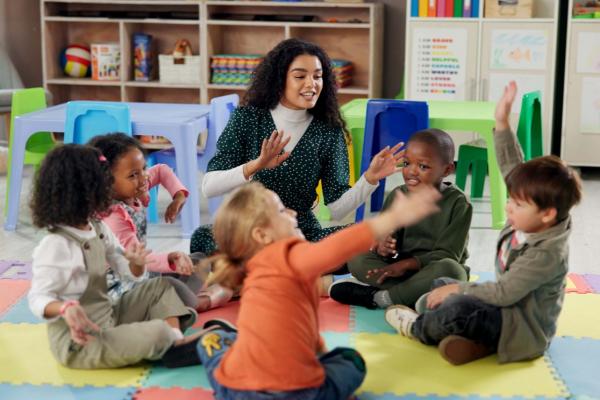
Four-year-old Rashad seems happy in his new pre-kindergarten classroom. His teacher, Marissa, looks forward to seeing his smiles each day and enjoys watching him play with the other children, but she also has some concerns. She has noticed that Rashad’s language is a little delayed and that he is having difficulty mastering some of the skills that the other children in her class are learning rapidly such as recognizing letters, printing his name, and participating during read aloud activities. Rashad’s parents have expressed similar concerns about Rashad’s lack of interest in books at home. One child in Marissa’s class has an Individualized Education Program (IEP) and Marissa has been working with a speech-language pathologist to incorporate this child’s therapy goals throughout the daily curriculum. Marissa doesn’t think Rashad needs help from a specialist just yet, but she wonders if she could be doing more to help Rashad learn key school readiness concepts that will prepare him for kindergarten in the fall .

Why Recognition and Response?

Some young children show signs that they may not be learning in an expected manner, even before they begin kindergarten. These children may exhibit problems in areas such as language development, phonological awareness, perceptual-motor abilities, and attention, which have been considered precursors of learning disabilities in older children. However, under current state and federal guidelines, these children are unlikely to meet eligibility criteria for having a learning disability. This is because formal identification of a child’s learning disability generally does not occur until there is a measurable discrepancy between the child’s aptitude and academic achievement, often not until the second or third grade.

What is Recogntion and Response?

Recognition and Response (R&R) is a multi-tier system that holds promise for pre-kindergarten children who experience learning difficulties in the areas of language, cognition, and academic learning. This model is consistent with the wisdom and values of the early childhood field because it emphasizes high quality curriculum and instruction and the importance of early intervening using research-based methods. Some three- to five-year-olds will require additional supports to acquire key school readiness concepts prior to kindergarten, even when teachers use effective curriculum and intentional teaching. R&R is designed to help early childhood teachers recognize children who show signs of learning difficulty and respond in ways that help them experience early school success. R&R is an emerging early childhood practice, and the tools and resources (e.g., assessment strategies, instructional approaches) that are necessary to support its implementation in early childhood settings are still being developed. However, many components of R&R, such as intentional teaching and providing a high quality learning environment, are already in place in most high quality early childhood classrooms. With these elements in place, early educators might begin using this approach to (a) determine whether most children are making adequate progress in key domains of learning and development and (b) respond to individual children who require additional supports to learn.

R&R is comprised of four main components: (1) Recognition: screening, assessment, and progress monitoring; (2) Response: research-based curriculum and instruction for all children and effective interventions for individual children who need additional supports; (3) Multiple tier framework: an intervention hierarchy; and (4) Collaborative problem-solving process: involving teachers, specialists, and parents for making instructional decisions. These components are illustrated in the figure below.

R&R conceptual model triangle

For more detailed information about the components of R&R, please visit our partner site developed and maintained by NCLD (www.recognitionandresponse.org) or click on “Citations” to find articles and reports written by the FPG R&R team.

Key Staff:

Co-Principal Investigators: Mary Ruth Coleman and Virginia Buysse
Associate Director: Jennifer Neitzel
Research Staff: Tracey West and Margaret Gillis

Implementation Partners:

(1) National Center For Learning Disabilities
(2) National Association for the Education of Young Children
(3) Communications Consortium Media Center
(4) Arizona Literacy and Learning Center
(5) Association for Children of New Jersey
(6) Connecticut Department of Education
(7) Florida Diagnostic and Learning Resource System
(8) Maryland Committee for Children

[more on partners..]


This project is funded by grants from the Emily Hall Tremaine Foundation